Sample frames for this project are available under NDA. Write to bilal@wortel.ai and we will share the relevant before and after pairs.
Project overview
Agricultural field images were annotated for a computer vision dataset focused on detecting and segmenting different types of weed. The work involved identifying black grass and rye grass in field environments and creating precise segmentation masks around the target weeds.
The main objective was to generate high-quality training data for an AI-based segmentation model capable of distinguishing and segmenting different weed species in agricultural fields.
Work performed
- Reviewed and organised the agricultural field image dataset before annotation.
- Identified black grass and rye grass plants in each image.
- Created precise polygon segmentation masks around visible weed plants.
- Labelling was kept consistent across both weed classes.
- Black grass was carefully differentiated from rye grass and surrounding vegetation.
- Annotated partially visible weeds where applicable.
- Visible plant boundaries were followed as accurately as possible.
- Performed quality checks and corrected inaccurate or incomplete segmentation masks.
- Ensured the annotations were consistent and suitable for training a computer vision segmentation model.
What made it hard
- Differentiating black grass from rye grass on visual characteristics alone.
- Similar-looking grass species made accurate classification difficult.
- Thin, narrow grass leaves demanded precise polygon placement.
- Dense vegetation obscured the boundaries of individual weeds.
- Overlapping plants required careful segmentation to avoid including neighbouring weeds.
- Partially visible weeds needed accurate boundary estimation.
- Growth stage differences produced wide variation in plant size and appearance.
- Soil, crops and other vegetation created complex backgrounds.
- Keeping segmentation boundaries accurate across multiple weed classes demanded sustained attention to detail.
Result
A high-quality black grass and rye grass weed segmentation dataset was completed with precise polygon annotations. The dataset was prepared for training a computer vision model capable of automatically detecting and segmenting different weed species in agricultural fields.
Final deliverable
Accurate and consistent polygon segmentation masks for the Black_Grass and Rye_Grass classes were delivered across the dataset. The final annotations were prepared to the project requirements and were ready for AI model training and automated agricultural weed detection and monitoring applications.
Related work
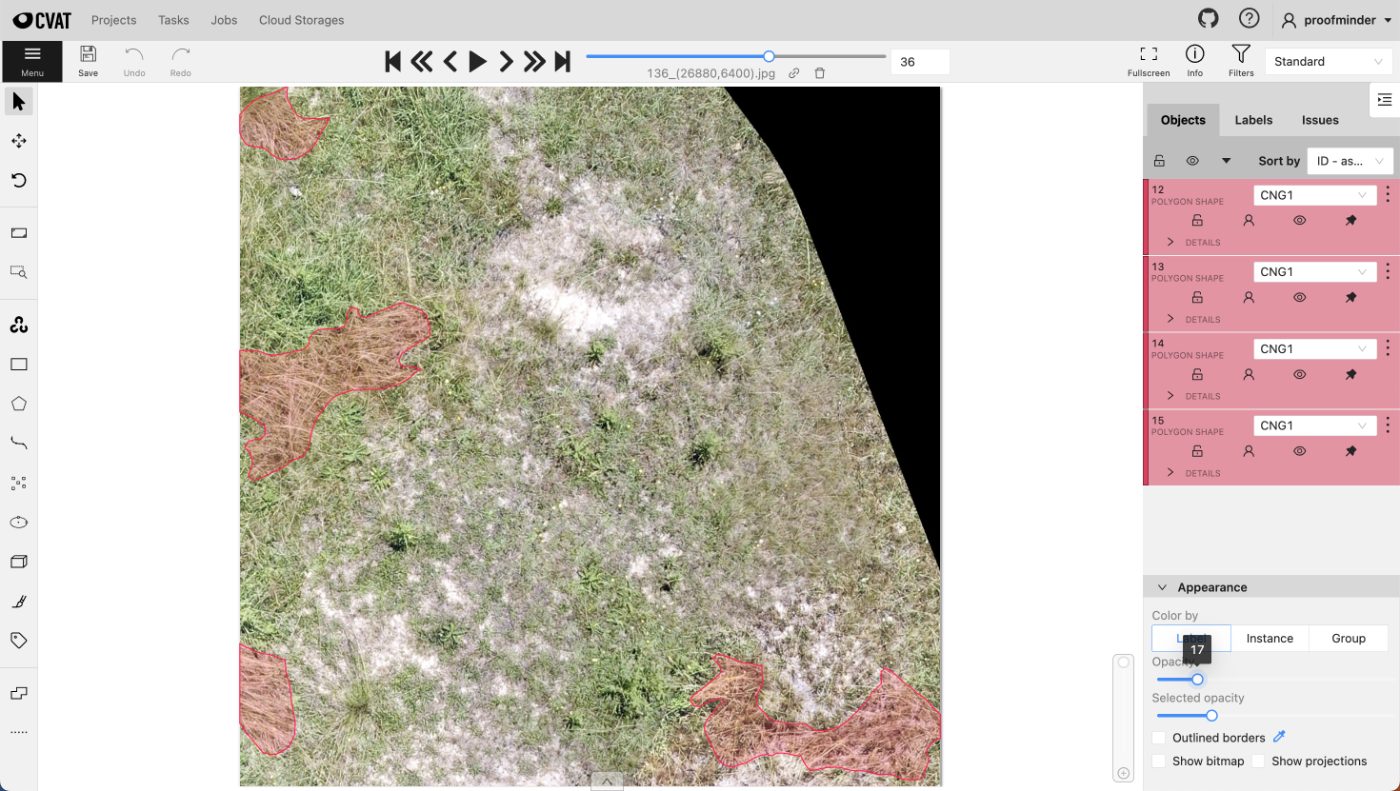
Aerial Orthomosaic Segmentation
Whole-site orthomosaics segmented into vegetation, water and bare ground across tiles stitched from multiple flights.
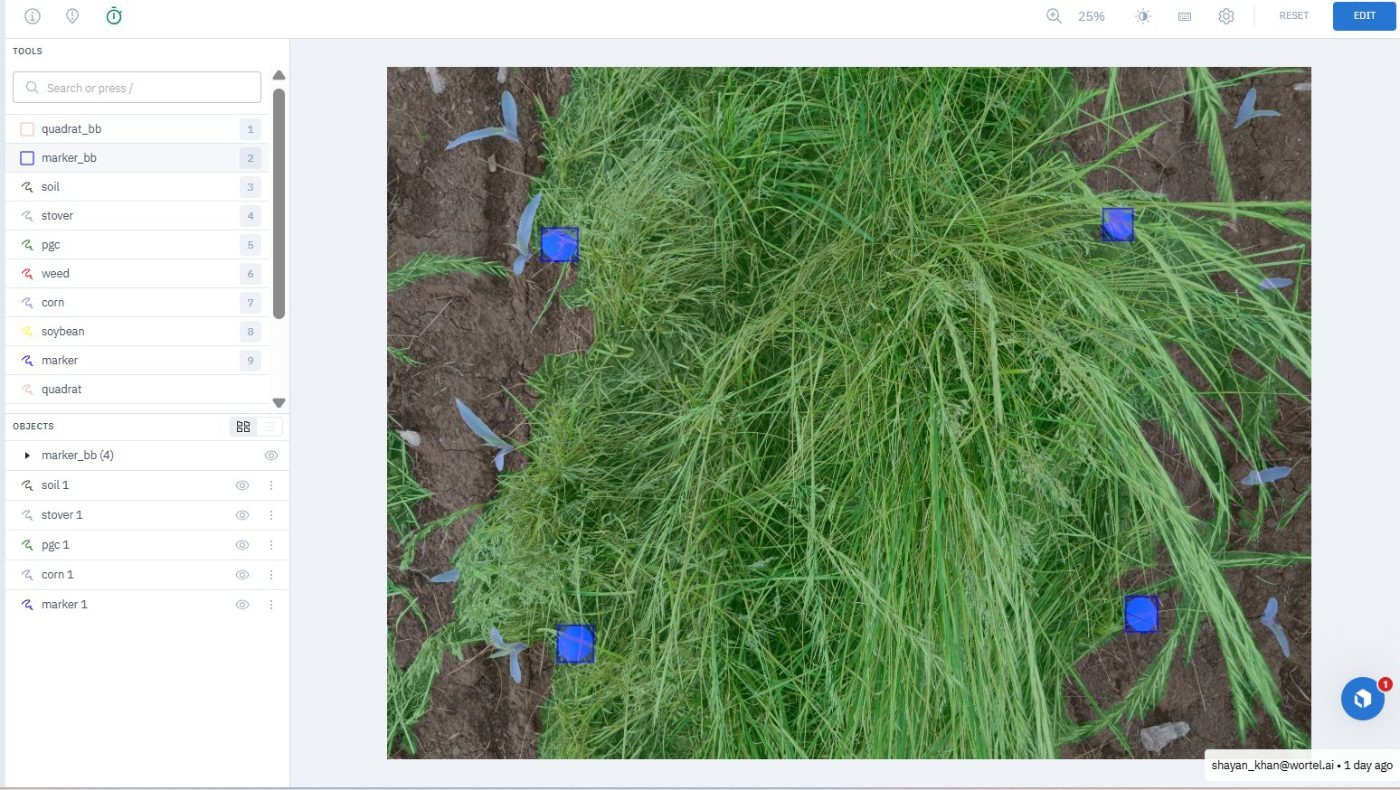
Ground Cover Quadrat Segmentation
Green cover, residue and bare soil segmented inside survey quadrats, with the quadrat frame itself located per image.
Black Grass Segmentation
Polygon masks isolating black grass from crops and similar-looking grasses across dense agricultural field imagery.