Sample frames for this project are available under NDA. Write to bilal@wortel.ai and we will share the relevant before and after pairs.
Project overview
Agricultural field images were annotated for a computer vision dataset focused on detecting vole holes in agricultural environments. The work involved identifying every visible vole hole and producing accurate annotations to generate high-quality training data for an AI-based object detection model.
Vole holes are small, clean-cut openings in the ground measuring roughly one to two inches wide. They connect to surface runways and underground tunnels created by voles, small rodent pests that eat plant roots, bulbs and bark.
Work performed
- Reviewed and organised the vole hole image dataset before annotation.
- Identified visible vole holes across the agricultural field images.
- Drew accurate bounding boxes around each visible vole hole.
- Consistent labelling was maintained using the Vole_Hole class.
- Partially visible or unclear holes were annotated where applicable.
- Vole holes were carefully distinguished from soil patches, rocks, shadows and other field objects.
- Performed quality checks and corrected inaccurate or incomplete annotations.
- Ensured the annotations were suitable for training a computer vision object detection model.
What made it hard
- Identifying small vole holes against complex soil and vegetation backgrounds.
- Telling genuine vole holes apart from natural soil patterns, rocks and shadows.
- Handling holes that were only partially visible or obscured.
- Soil conditions, lighting and image quality varied widely across the dataset.
- Keeping bounding boxes tight and consistent around irregularly shaped holes.
Result
A high-quality vole hole detection dataset was completed with accurate bounding box annotations. The dataset was prepared for training a computer vision model capable of automatically detecting vole holes in agricultural environments.
Final deliverable
Accurate and consistent bounding box annotations for vole holes were delivered across the dataset. The final output was prepared to the project requirements and was ready for AI model training and agricultural field monitoring applications.
Related work
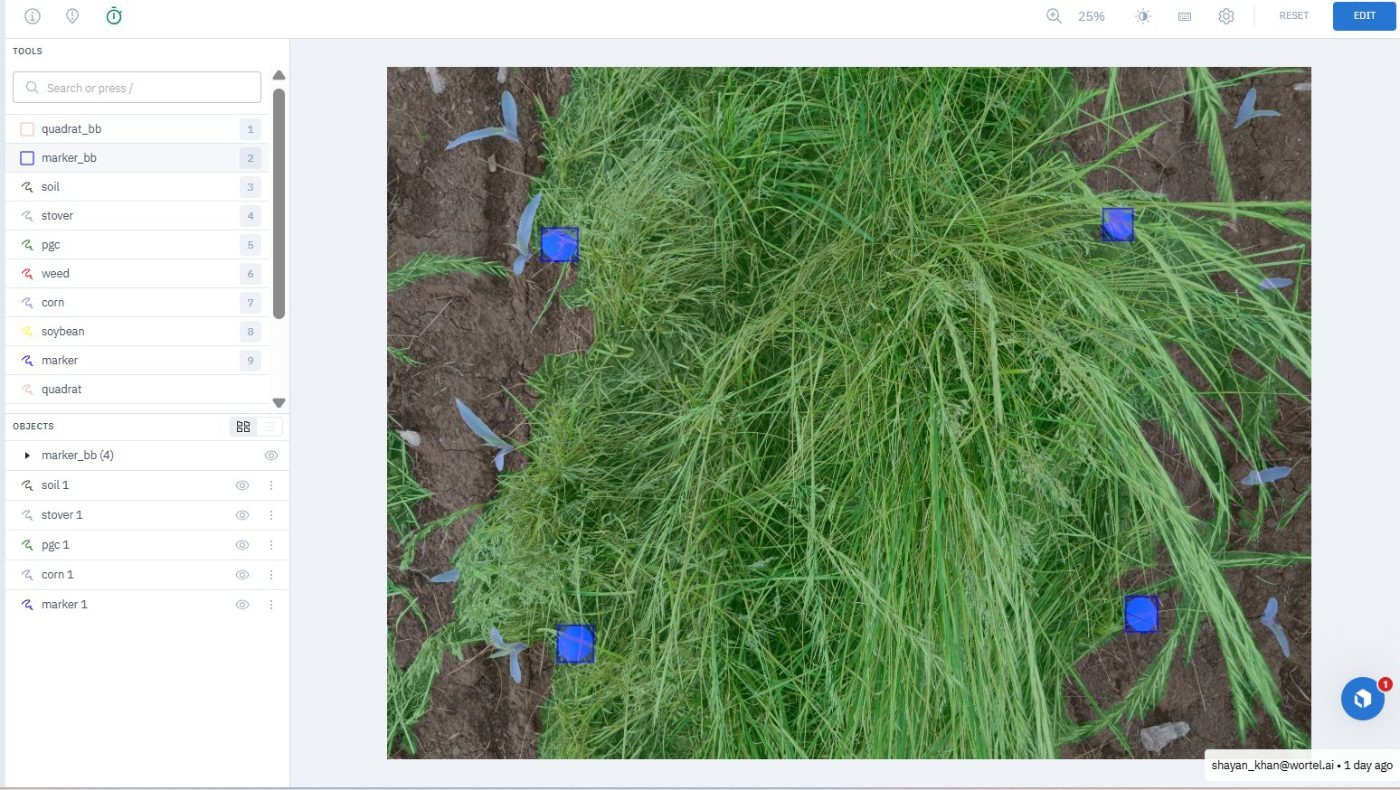
Ground Cover Quadrat Segmentation
Green cover, residue and bare soil segmented inside survey quadrats, with the quadrat frame itself located per image.
Almond Tree Detection
Bounding boxes around individual almond trees in top-down drone imagery, where shadows and neighbouring vegetation mimicked real trees.
Apple Detection
Bounding boxes around individual apples on tree branches, where dense leaves and occlusion hid much of each fruit.