Sample frames for this project are available under NDA. Write to bilal@wortel.ai and we will share the relevant before and after pairs.
Project overview
Agricultural field images were annotated for a computer vision dataset focused on segmenting cotton plants in real-world field environments. This was a challenging segmentation project because it required precise segmentation masks for cotton plants while also differentiating them from surrounding weeds and other vegetation.
The primary objective was to produce high-quality segmentation annotations that could be used to train an AI model to accurately identify cotton plants in complex agricultural environments.
Work performed
- Reviewed and organised the agricultural field image dataset prior to annotation.
- Identified cotton plants across varying field conditions.
- Created precise polygon segmentation masks around visible cotton plants.
- Cotton plants were carefully differentiated from surrounding weeds and unwanted vegetation.
- Followed visible plant boundaries to maintain segmentation accuracy.
- Partially visible cotton plants were annotated where applicable.
- Managed overlapping cotton leaves and nearby vegetation.
- Consistent labelling was maintained using the Cotton class.
- Performed detailed quality checks to identify and correct inaccurate or incomplete masks.
- Ensured the final annotations were suitable for training a computer vision segmentation model.
What made it hard
- Cotton plants and weeds often grew very close to one another.
- Some weeds had similar shapes, colours, and leaf structures.
- Overlapping leaves made boundaries difficult to delineate.
- Dense vegetation created complex segmentation areas.
- Certain cotton plants were partially obscured by weeds or other plants.
- Variation across growth stages changed cotton plant size and appearance.
- Shadows and inconsistent lighting affected visibility.
- Precise polygon placement was required to avoid including weeds in cotton masks.
- Maintaining consistent quality across a large dataset required careful review.
Result
A high-quality cotton segmentation dataset was delivered with precise polygon annotations, ready for training a computer vision model capable of accurately segmenting cotton plants while distinguishing them from surrounding weeds and vegetation.
Final deliverable
Accurate, carefully reviewed segmentation masks for cotton plants were delivered throughout the dataset. Despite the difficulty of differentiating cotton from visually similar weeds and handling dense, overlapping vegetation, the final annotations met project requirements and were ready for AI model training and agricultural computer vision applications.
Related work
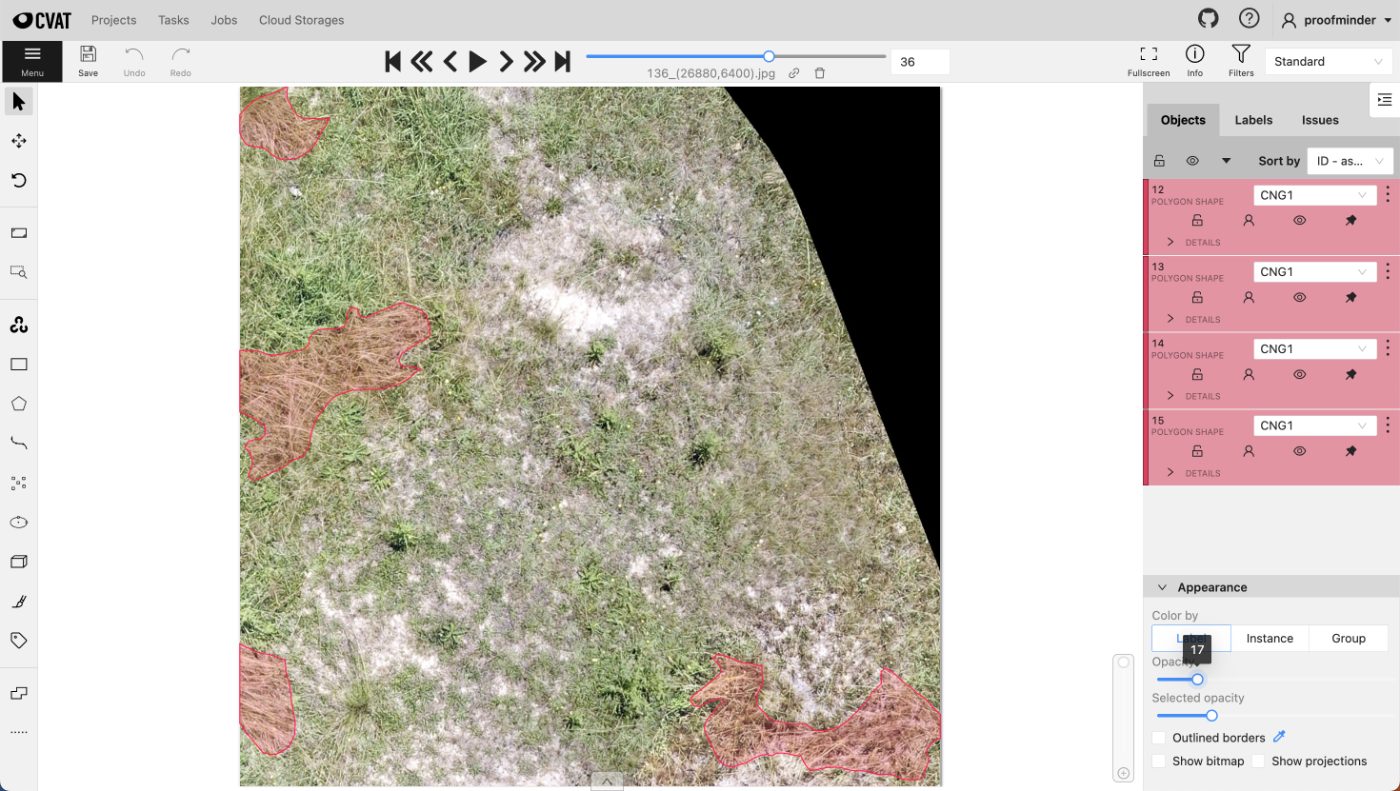
Aerial Orthomosaic Segmentation
Whole-site orthomosaics segmented into vegetation, water and bare ground across tiles stitched from multiple flights.
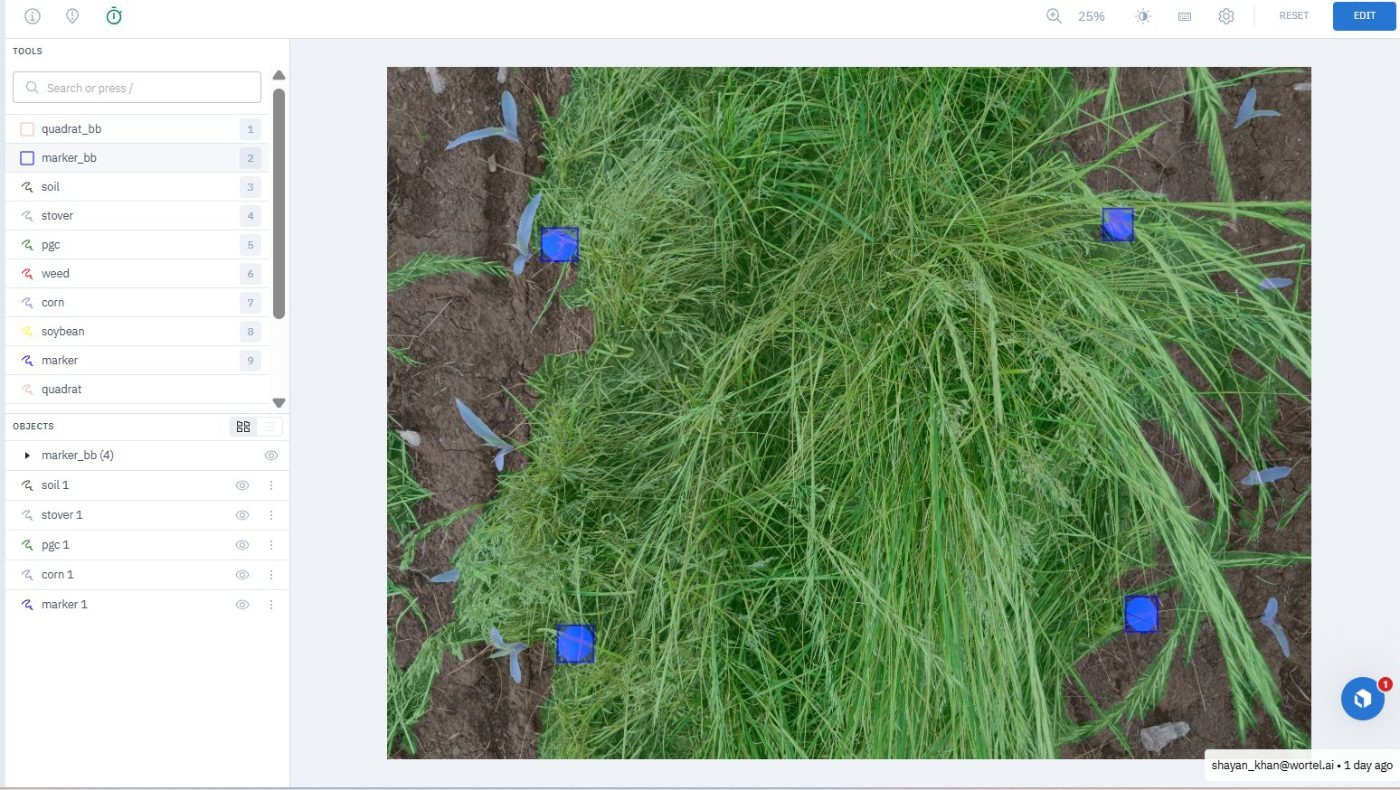
Ground Cover Quadrat Segmentation
Green cover, residue and bare soil segmented inside survey quadrats, with the quadrat frame itself located per image.
Black Grass Segmentation
Polygon masks isolating black grass from crops and similar-looking grasses across dense agricultural field imagery.