Sample frames for this project are available under NDA. Write to bilal@wortel.ai and we will share the relevant before and after pairs.
Project overview
Property and real estate images were annotated for a computer vision dataset designed to detect vehicle licence plates for privacy protection. Accurate four-point polygon annotations were created to generate high-quality training data for an AI model capable of automatically detecting and blurring licence plates before property images are published, replacing a third-party detector prone to false positives.
Work performed
- Reviewed and organised the property image dataset before annotation.
- Accurate four-point polygon annotations were created around every visible licence plate.
- A consistent corner convention, starting bottom-left and running upward, made every polygon machine-comparable.
- Images containing no plates were confirmed and marked as verified-empty negatives.
- Annotation consistency was maintained across all images and rounds.
- Quality assurance checks included a geometry audit that flagged and corrected anomalous polygons before delivery.
- Completed annotations were delivered in COCO 1.0 format according to client requirements.
What made it hard
- Annotating extremely small plates, with a median plate width of 91 px on 4,000 px images and the smallest at 12 px.
- Rotated quadrilaterals rather than axis-aligned boxes were needed so angled plates are enclosed tightly without including bumper and paintwork.
- Genuine plates had to be distinguished from phone numbers on van signage, permit stickers, house numbers and reflective badges.
- Plates that were partially occluded, clipped by the image edge, or seen at extreme angles required careful handling.
- A consistent corner ordering across thousands of polygons was needed to keep the data usable for key point training.
- Disputed annotations where the model and the original labels disagreed called for repeat review passes.
Result
A high-quality annotated dataset was delivered for privacy-aware computer vision applications. The dataset was used to train licence plate detection models that reduced missed plates from 39 to 4 on a held-out test set, improving detection against the client's deployed system.
Final deliverable
Annotation of 2,328 property images was completed, comprising 3,267 licence plate polygons and 584 verified-empty negatives, using a single plate class annotated as four-point rotated quadrilaterals with a consistent corner convention. Delivery spanned three annotation rounds with repeat quality-assurance passes, and the dataset was prepared for training an AI-powered automatic licence plate blurring system.
Related work
Face Blur & Picture Frame Detection
Picture frames masked and faces boxed in property photos, separating real faces from artwork for automatic privacy blurring.
Sky Segmentation & Mask Preparation for Sky Replacement
Refined binary sky masks for property photographs, holding clean edges around rooftops, trees and poles for realistic sky replacement.
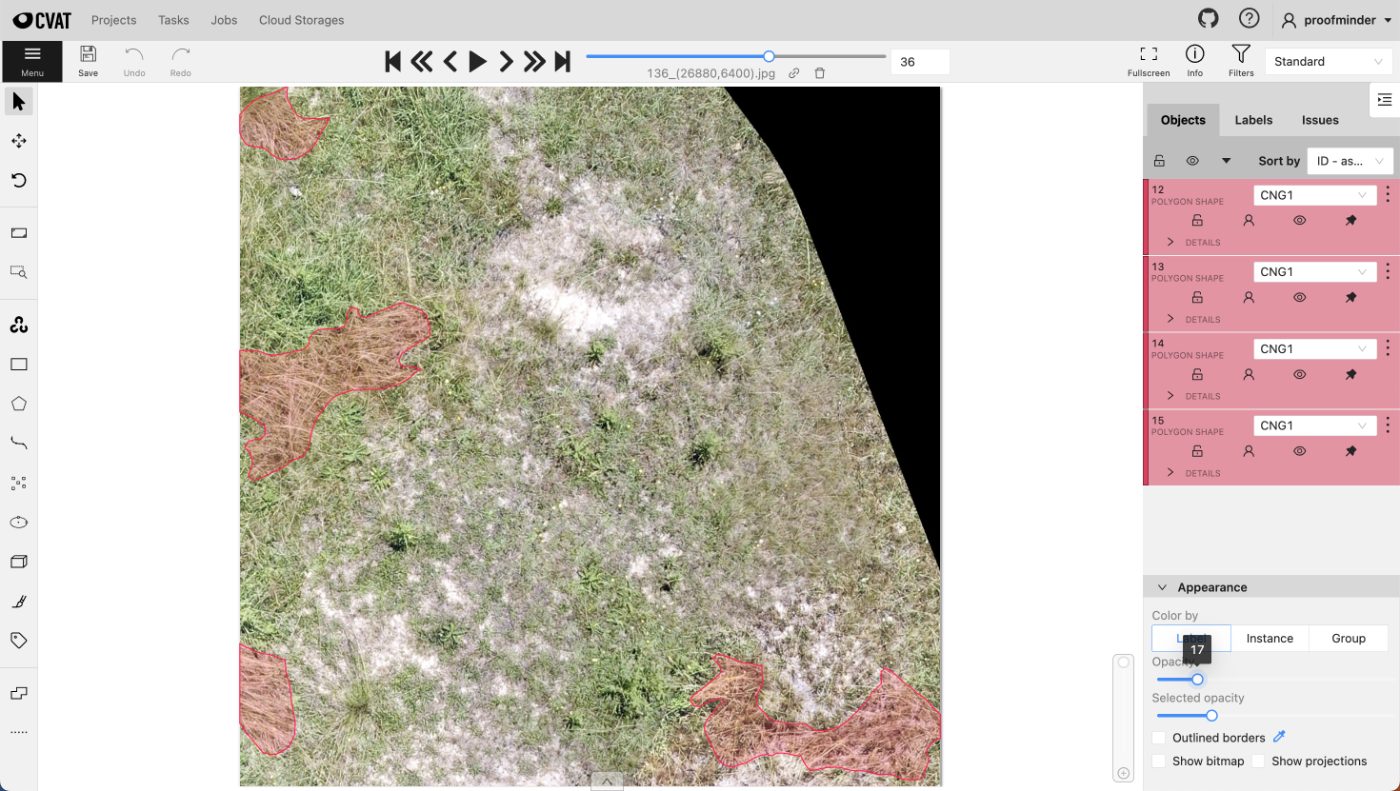
Aerial Orthomosaic Segmentation
Whole-site orthomosaics segmented into vegetation, water and bare ground across tiles stitched from multiple flights.